Interface Design
Human–AI Interaction
User Agency
Law Enforcement
Team
Alma Bülow
William Van Der Bijl
Yadu Sharon
Time
2025 - 8 weeks
My contribution
Research, Concept,
Screen Design
Summary
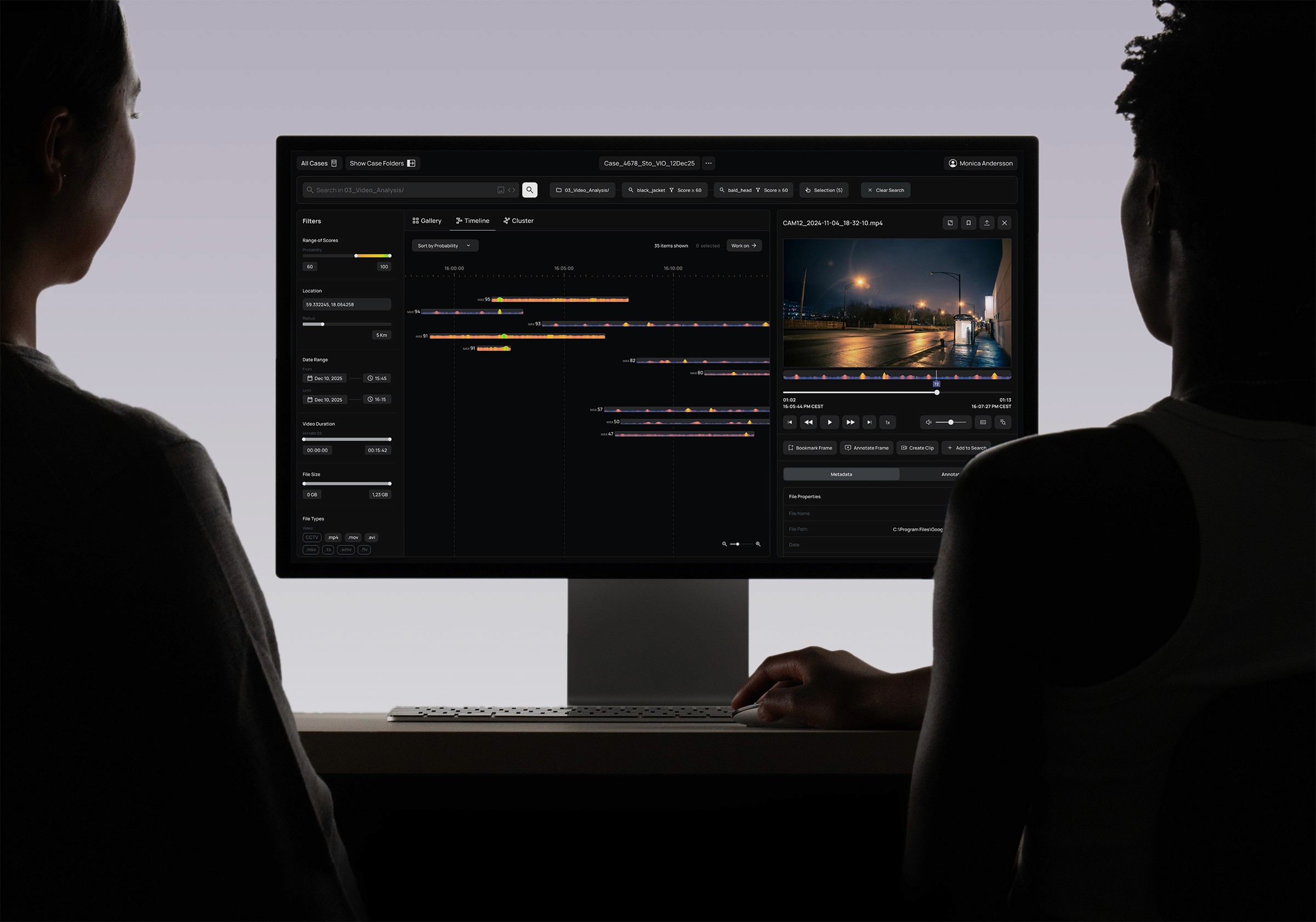
Developed in collaboration with Europol and the swedish police, this project addresses the challenge of processing large volumes of video data in investigative settings. Law enforcement agencies increasingly rely on AI-supported search to navigate evidence collected from diverse sources. The task was to design a user interface that enables efficient, adaptive, and responsible analysis of video material. Grounded in field research, the resulting system supports prompting, filtering, and visualizing data in ways that reflect real investigative workflows.
System Overview
The interface is structured around three core components.
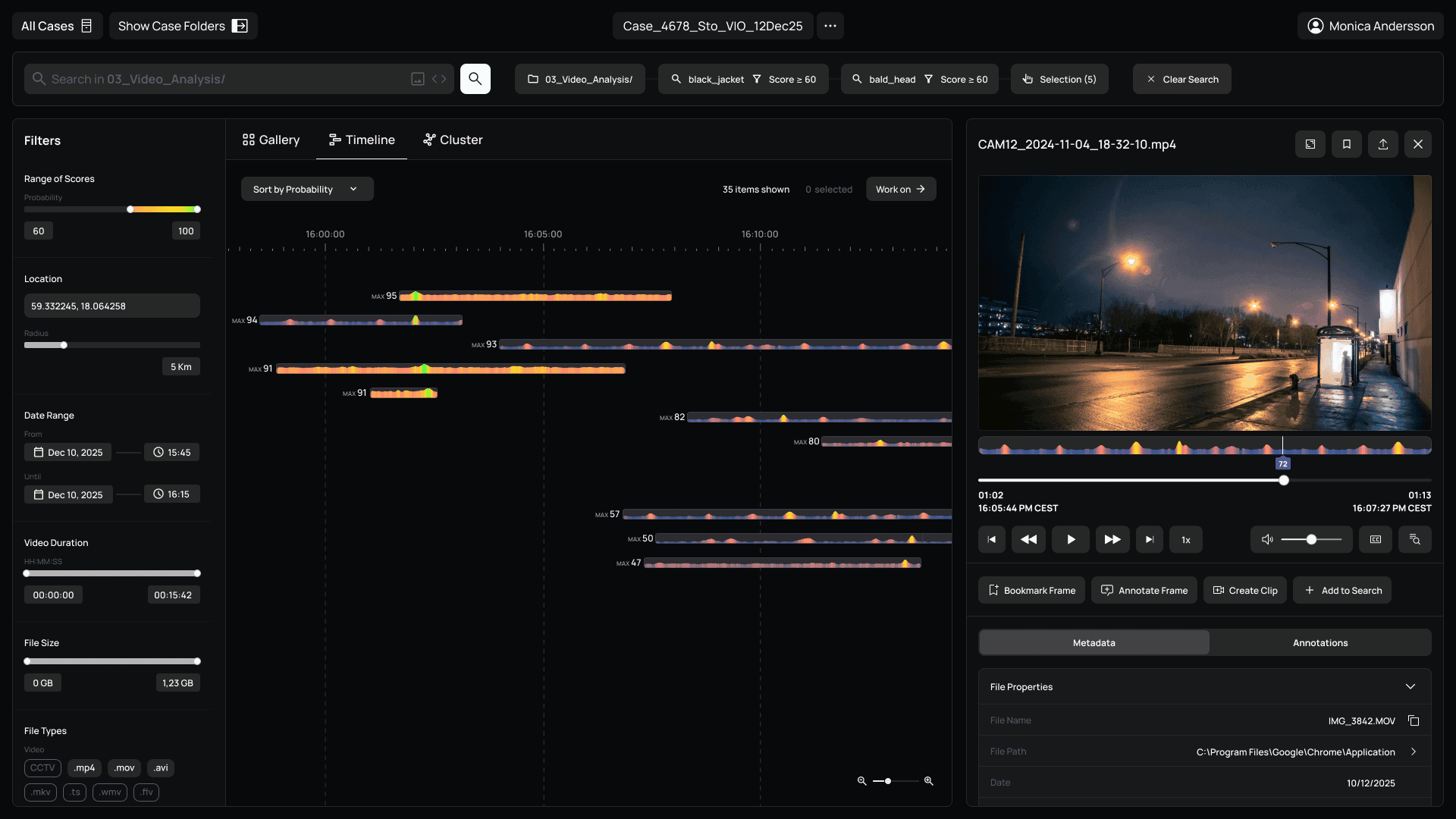
Search Bar
Initiates AI-supported visual search across large video datasets. Investigators can search for objects, or visual attributes using text or image input.
Data Explorer
Provides multiple ways to browse and understand the dataset. Different views allow investigators to switch between focused inspection and exploration.
Media Player
Enables detailed inspection of individual videos and sequences. Investigators can review footage while keeping contextual information visible.
more content coming soon
Reflection
Aletheia made me reflect on the role interaction design plays in shaping how AI is used in different contexts. Working in a high-stakes domain like law enforcement video analysis highlighted that decisions about what a system doesn’t do can be just as important as what it does. Instead of designing AI to deliver conclusions, we explored how interaction design can preserve human judgment through visible uncertainty, reversible actions, and incremental narrowing of data. That reframing, that limiting automation can itself be a productive design strategy, is something I've carried forward into how I think about human–AI interaction more broadly.
©2026 Pius Burkhart